New York Slip and Fall Lawyer
A New York slip and fall lawyer from Meirowitz & Wasserberg can help you file a claim after a slip, trip, or fall caused by someone else’s negligence. To recover damages, you must show the property owner created, knew about, or should have known about the hazard and failed to act. You generally have three years to file, but only 90 days if the City of New York is involved. We’ve recovered over $500 million for clients across New York. Contact us to find out if you have a claim.
Expertise
Samuel Meirowitz is “Top 100 Trial Lawyer” and an accomplished personal injury lawyer, trial attorney and relentless advocate for his clients. Previously, he served the State of New York for four years as a prosecutor in the Bronx District Attorney’s office. Mr. Meirowitz is admitted to practice law in New York and Florida State Courts.
Content written by Samuel Meirowitz
Samuel Meirowitz is “Top 100 Trial Lawyer” and an accomplished personal injury lawyer, trial attorney and relentless advocate for his clients. Previously, he served the State of New York for four years as a prosecutor in the Bronx District Attorney’s office. Mr. Meirowitz is admitted to practice law in New York and Florida State Courts.
Experienced Personal Injury Attorney
Quick Links
"Premises liability is an umbrella term for personal injuries that occur on someone else's property and slip and fall is a generic term."
"If you were in a supermarket and you were walking down an aisle and there was spilled olive oil... The store would have noticed that that olive oil was there, because they're the ones that created the condition. If somebody comes by and slips and falls on that olive oil, the store is going to be held responsible for those injuries."
What Makes a Valid Slip and Fall Accident Claim in New York?
The New York City civil courts require specific elements of proof for a plaintiff to recover damages after a slip-and-fall. It’s important to seek help from a knowledgeable NYC personal injury lawyer for these cases. Otherwise, you could make a mistake that leads to the courts dismissing your claim, even if it has merit. Understanding when you may sue for a slip-and-fall can help you take appropriate legal action.
The Negligence Requirement
In New York, you must prove that the defendant owned or controlled the property and that they were negligent in its care. The property owner had to have known, or reasonably should have known, about the hazard that caused the accident and did nothing to fix it or warn about it.
If the property owner had no reasonable way of knowing about the hazard, or if another prudent owner wouldn’t have noticed the hazard, the courts may not find them guilty of negligence. However, if the owner had constructive notice — meaning the hazard existed long enough for them to have known — they could be held liable.
Common Hazardous Conditions in NYC
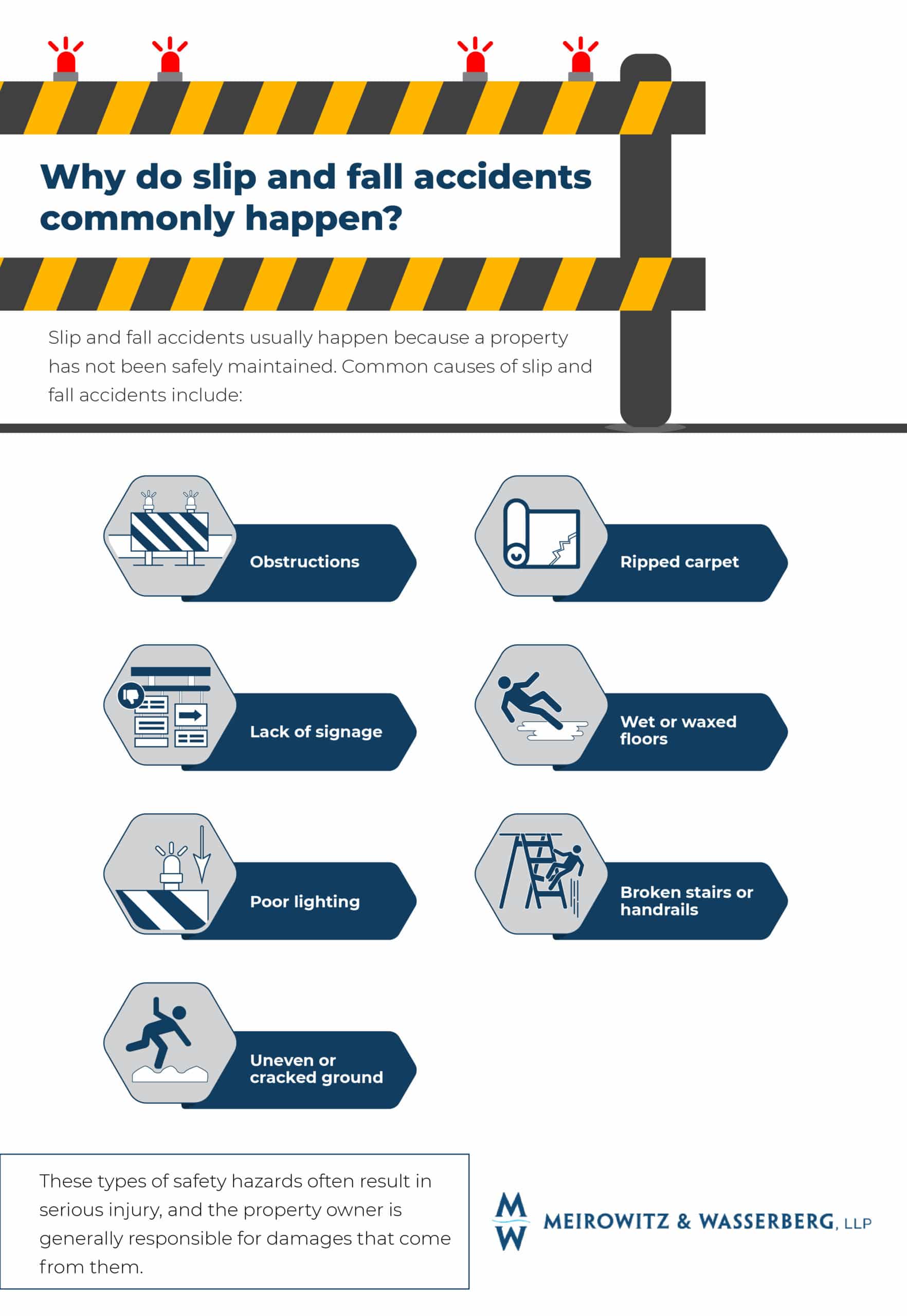
NYC is a large city with many older buildings, and hazardous conditions can include wet floors, broken stairs, uneven pavement, black ice or inadequate lighting. Accidents can happen in subway stations, building lobbies, construction scaffolding, bodegas, walkways and parking garages.
NYC Sidewalk Laws and Property Owner Liability
In many cases, NYC sidewalk laws put the responsibility for maintaining sidewalks on property owners, not the city. NYC’s Administrative Code section 7‑210 says the owner of the property adjacent to the sidewalk is liable for any defects that cause injuries.
Under the law, smaller residential properties, such as one-, two-, or three-family homes, are owner-occupied and used only as residences. These properties are usually exempt from Admin Code 7-210, so the city may be the defendant for sidewalk hazards in front of those homes. This protection doesn’t apply to apartment buildings, mixed‑use properties or commercial spaces like shops and offices.
Depending on where your injury occurred, you could pursue a claim against a property owner or the City of New York. It’s crucial to speak with a lawyer to determine which party is responsible.
When the City of New York Is Liable
If you are suing the City of New York, there are deadlines to file your case that are shorter than when you file against a private owner. First, you must file a Notice of Claim within 90 days. Then, you have one year and 90 days to file your actual lawsuit, so acting quickly is critical.
Damages Available in a New York Slip and Fall Case
Damages available in New York slip and fall cases include economic damages, such as medical expenses, and non-economic damages, such as loss of quality of life.
Damages You Can Recover
- Medical expenses (current and future)
- Lost wages and earning capacity
- Pain and suffering
- Rehabilitation and long-term care costs
An experienced lawyer with Meirowitz & Wasserberg can help you get the maximum compensation for the damages you are entitled to under city and state law.
Common Injuries From Slip and Fall Accidents
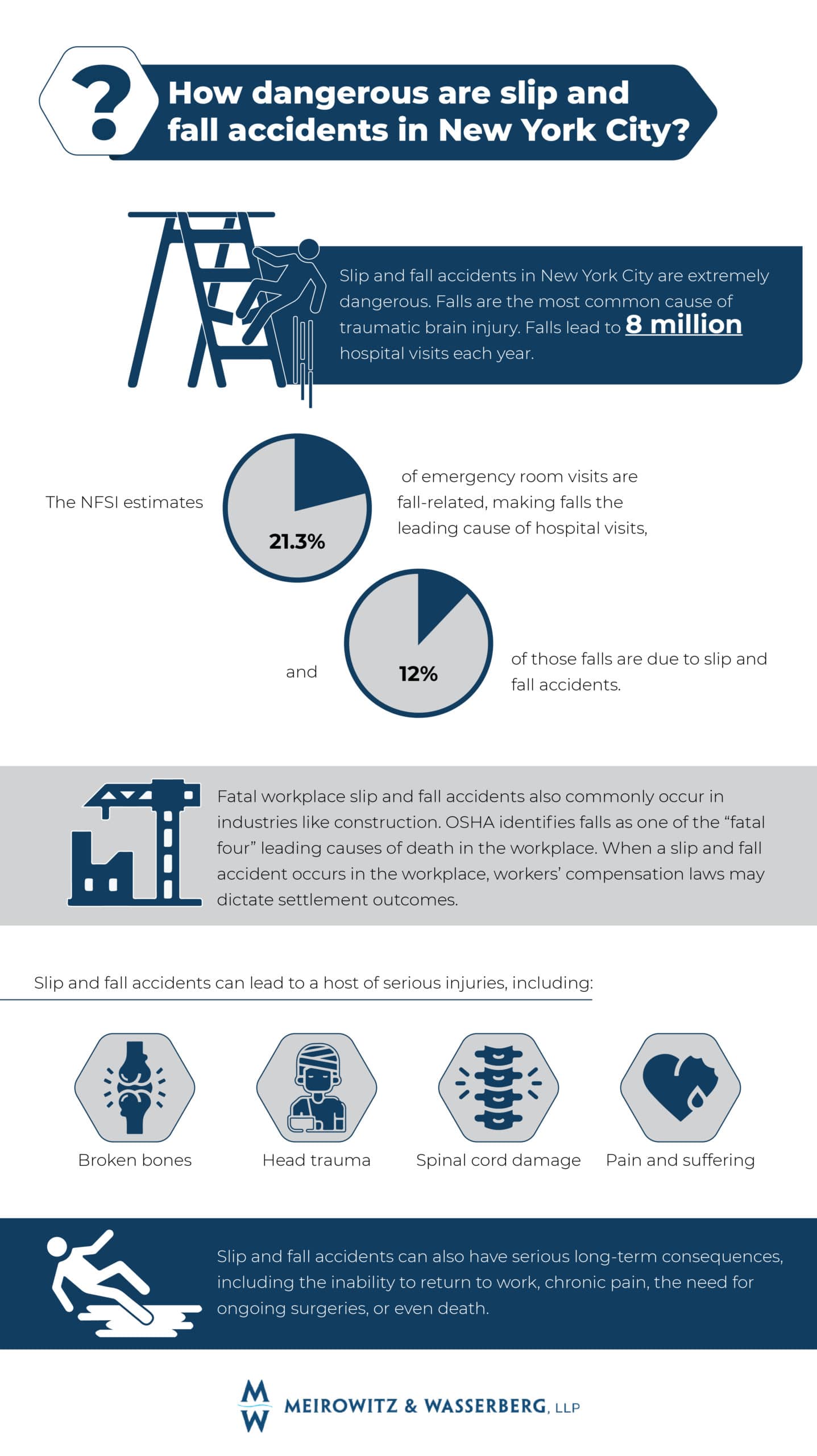
Slip and fall accidents in New York City can be extremely dangerous. According to the CDC, falls lead to about 3 million emergency room visits and 1 million hospitalizations each year. Falls are also the most common cause of traumatic brain injury.
Examples of Injuries From Slip and Fall Accidents
- Broken bones and fractures (hip, wrist, ankle)
- Knee and shoulder injuries
- Traumatic brain injury and head trauma
- Soft tissue injuries (sprains, tears)
- Spinal cord damage
Fatal workplace accidents commonly occur in industries like construction. OSHA identifies falls as one of the “fatal four” leading causes of death in the workplace. When a slip and fall accident occurs in the workplace, workers’ compensation laws may dictate settlement outcomes.
Injuries from slip and fall accidents can also have serious long-term consequences, including the inability to work, chronic pain, the need for ongoing surgeries or even death.
How New York's Comparative Negligence Rule Affects Your Claim
New York state slip and fall accidents are governed by comparative negligence laws (NY CPLR section 1411). These laws could reduce your recovery, but they do not prevent you from filing a lawsuit. Instead, the extent to which you are at fault is weighed against the property owner’s negligence. For example, if you’re 20% at fault because you were texting and not paying attention to your surroundings when you were injured, you may still recover 80% of damages.
If you’re injured in an accident where you may be at least partially at fault, it’s even more important to consult with and be represented by an experienced attorney. Insurance companies for property owners could try to minimize your recovery, so a lawyer can help make sure your recovery is the maximum percentage allowed to you under the law.
How a New York Slip and Fall Attorney Builds Your Case
A New York slip and fall attorney strengthens your claim by moving quickly to secure evidence, document your injuries and tie everything back to the property owner’s legal duties. This early legwork often makes the difference between a weak claim and a strong, well‑supported case.
In order to prove a slip and fall accident in New York City, you need to have two, either one of three things. First, you need to prove what is called ‘actual notice.’ This means that whoever is responsible for that property knew about the issue that caused your fall prior to your fall.
Secondly, you can also prove your case through ‘constructive notice.’ Here, you have to gather enough facts to determine that whatever it was that caused you to fall was there for a long enough time that the responsible person for this property should have discovered it or should have known about it and remedied that condition prior to your fall.
Last but not least, there’s a theory where you can recover for slip and fall accidents, which is called ’cause and create.’ This is where either the person responsible for that property, or an employee or an agent of this person, caused the condition that eventually led to your accident.

Evidence Your Attorney Will Secure
Evidence your attorney will secure includes surveillance footage, incident and maintenance records, witness statements and medical records.
A key step is tracking down surveillance footage from the property or nearby businesses, since many systems automatically overwrite video within days or even hours. Attorneys will send preservation letters asking owners to save footage from the time of the fall. They also obtain incident reports, maintenance logs, cleaning schedules and repair records to show how long the hazard existed and whether the owner was doing reasonable inspections.
Witness statements are gathered early, while memories are fresh, to describe what the dangerous condition looked like and how the fall happened. Your lawyer will also collect medical records and bills that document when you first sought treatment, how your symptoms developed and what doctors say about the cause and long‑term impact of your injuries.
Why Acting Quickly After a Slip and Fall Matters
Critical evidence can disappear quickly, so acting quickly after a slip-and-fall is important. Ice melts, snow is shoveled away, spills are mopped up and warning cones are moved. Video footage can be erased, and physical conditions can be repaired before they are documented.
The sooner an attorney gets involved, the faster they can photograph the scene, gather witness accounts and notify the property owner to preserve video and records. Acting quickly gives your lawyer a stronger factual record to prove what happened, how the property was being maintained and why the owner should be held responsible.
Slip and Fall Deadlines in New York: When to Contact a Lawyer
New York imposes strict deadlines for slip and fall claims, and missing them can stop an otherwise strong case. It is important to know which deadline applies based on where your fall happened.
For most slip and fall accidents on private property in New York, you generally have three years from the date of the accident to file a lawsuit. Private properties can include apartment buildings, stores or office spaces.
Claims involving the City of New York (such as city‑owned sidewalks, parks and public buildings) are different. You must usually serve a written Notice of Claim within 90 days of the accident, then you have one year and 90 days from the accident date to file suit. Claims against certain transit entities, such as the MTA for subway or bus incidents, also require their own Notice of Claim within 90 days before a lawsuit can be filed.
In almost all premises liability cases, the clock starts on the date of the accident, not when you receive a diagnosis or when you realize your injuries are connected to the fall. Because these deadlines are technical and may have exceptions, speaking with a lawyer as soon as possible is the safest way to protect your rights.
Frequently Asked Questions About Slip and Fall Cases in New York
How long do I have to file a slip and fall lawsuit in New York?
You have three years to file for private property, 90 days to file a Notice of Claim for city/government entities and one year and 90 days to sue those entities.
What does a slip and fall lawyer in New York City do?
A slip and fall lawyer in New York City investigates the accident scene, preserves evidence, identifies liable parties, negotiates with insurers and litigates your case if necessary.
Can I still recover if I was partially at fault for my fall?
Yes, New York's pure comparative negligence rule reduces your recovery by your fault percentage, but it does not bar your claim. For example, if total damages are $100,000 and you were 20% at fault, you would get $80,000.
Who is responsible if I slipped on a New York City sidewalk?
Under NYC Admin Code 7-210, the adjacent property owner is typically liable, not the city. There are limited exceptions for certain residential buildings.
How do I choose the best slip and fall lawyer in New York?
Look for experience with premises liability cases in New York courts, a track record of verdicts and settlements and a firm that handles your case directly rather than referring it out. For example, lawyers at Meirowitz & Wasserberg appear in court in all of NYC’s boroughs, and we know state law. We’ve also recovered over $500 million for our clients, including $750,000 for a client who slipped and fell on wet paint outside a department store, resulting in foot and ankle fractures.
What is my New York slip and fall case worth?
The value of a slip and fall case in New York depends on injury severity, liability clarity, lost income and long-term medical needs. No standard amount exists, so a lawyer has to evaluate your specific situation.
AVAILABLE 24/7
Get Your Free Case Review
Notable Results
$200,000
Personal injury settlement
$235,000
Slip and fall injury
$675,000
Product liability injury
$555,000
Premises liability injury
I feel so blessed to have had Meirowitz & Wasserberg Law Firm represent my Husband and I in a great time of need in our lives. l highly recommend this firm. Daniel Wasserberg was the most personable, caring lawyer one could ever have. He was always there for our every need with compassion, loyalty and sincerity. He truly cares about his clients. I learned to love this man as a Son.